Skin science
Your body’s largestorgan.
Skin is a layered structure that protects you from the outside world, balances your temperature, senses touch and constantly renews itself. Getting to know it is the first step to the right care.
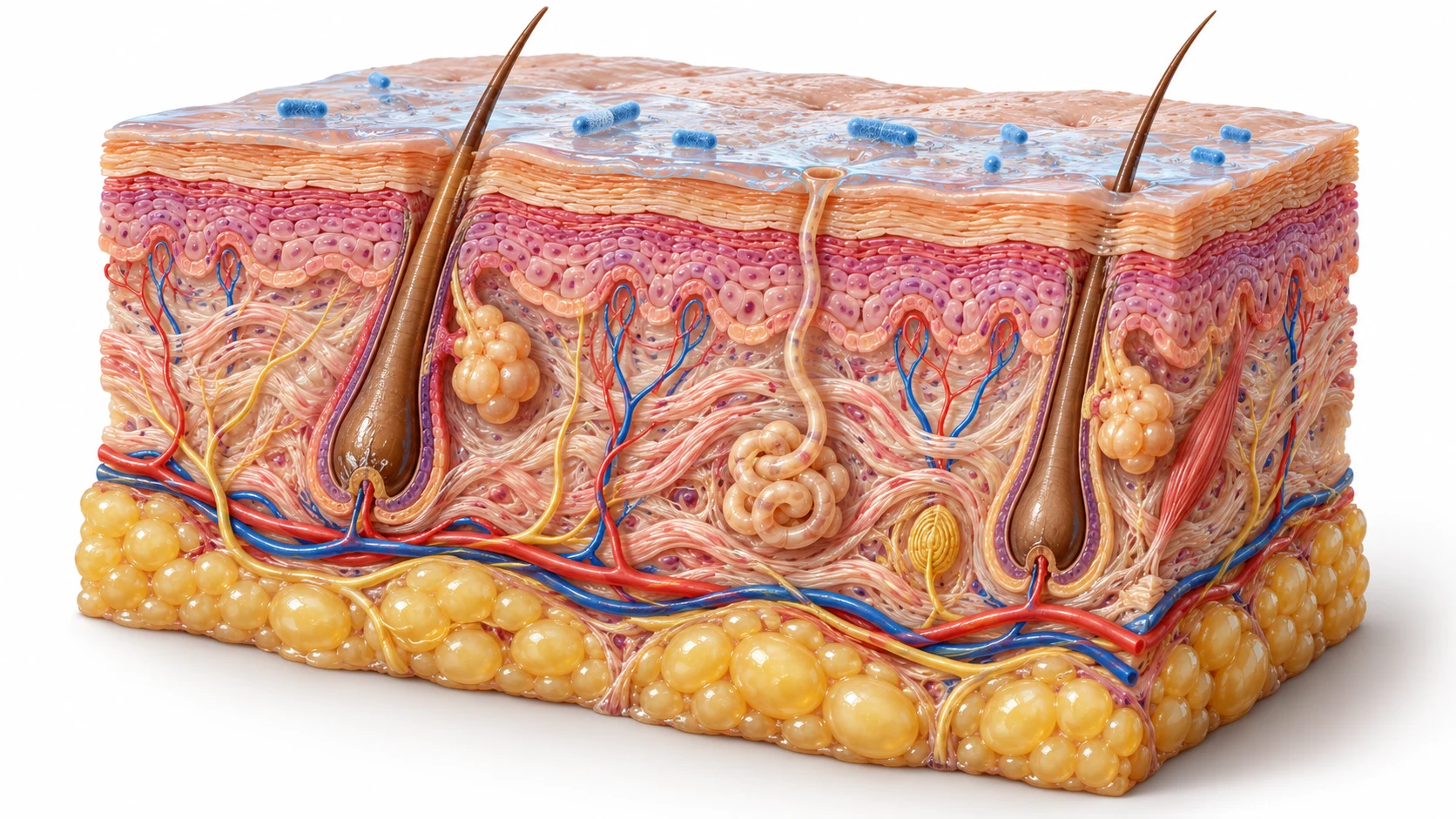
The architecture of skin
01Surface
The skin's surface is alive.
A community of bacteria and yeasts lives on the very top of your skin. When this community is in balance, skin stays calm, hydrated and resilient. Pores and hairs also open onto this surface.
The foundation of every routine
Four steps,for every skin.
Cleanse01
Start gently.
A cleanser that doesn't leave your skin tight, with little foam and a pH close to the skin's own. Light in the morning; in the evening, a cleanse that fully removes makeup and sunscreen.
Support02
Focus on your concern.
Vitamin C or azelaic acid for dark spots, niacinamide for pores, a retinoid for ageing. No more than one or two actives at a time, slowly and consistently.
Moisturise03
Feed the shield.
Ceramides, glycerin and hyaluronic acid hold water in your skin. Moisturisers with prebiotics and probiotics can help support the skin’s natural balance.
Protect04
SPF every day.
A broad-spectrum sunscreen of at least SPF 30. Against the biggest cause of wrinkles and dark spots, this is the most effective step in your routine.
Get to know your skin
Normal skin
Normal skin neither feels tight nor gets shiny by midday. Find out how to identify your skin type with the blotting paper test, and which simple skincare routine is enough to keep this balance for years.
Dry skin
If your face feels tight after washing, gets flaky and dries out even more in winter, you're not alone. Here we explain, step by step, what causes dry skin, what to do about it and which moisturizer actually works.
Oily skin
Is your face shiny by noon, are your pores visible, and do you break out (acne) often? Learn what causes oily skin and how to care for it: the goal isn't to dry it out, but to balance the oil.
Combination skin
Are your forehead and nose shiny while your cheeks feel tight? Combination skin is one of the most common types. Here's how to tell if you have it and how to build a routine that balances both zones at the same time.
Sensitive skin
Does your face sting with a new cream, turn red in the cold and burn at the slightest thing? Learn how to tell if you have sensitive skin and how to calm redness; more often than not, fewer but the right products make the biggest difference.
Mature skin
After your 40s and with menopause, is your skin getting thinner and drier and losing firmness? Learn how to care for mature skin: with the right ingredients, supporting hydration, firmness and radiance is possible at any age.
Keep reading
 What is the skin microbiome, and how do you keep it balanced?
 Damaged skin barrier: 9 signs and how to repair it
 Probiotics, prebiotics, postbiotics: what's the difference, and what do they do for skin?
 Is washing your face too much bad? How many times a day should you wash it?
 Your menstrual cycle and your skin: why you break out before your period, and what to do
 How does stress show up on your skin? Stress acne, itching and cortisol