Picture yourself standing in front of a skincare shelf. One bottle says probiotic, another says prebiotic, another says postbiotic. These words sound very similar, but they actually describe different things. Fortunately, each one has a clear definition agreed on by international scientists. Knowing these definitions helps you understand what you're using and why, and helps you spot exaggerated claims.
These three concepts were defined by expert panels convened by the International Scientific Association for Probiotics and Prebiotics (ISAPP) and published in the respected journal Nature Reviews Gastroenterology and Hepatology. Below, we base our explanations on these consensus definitions.
Probiotics: alive and beneficial
According to the consensus statement published in 2014, probiotics are live microorganisms that, when administered in adequate amounts, confer a health benefit on the host. This definition has three important parts: they are alive, they are present in adequate amounts and a health benefit has been demonstrated. So not every bacterium is a probiotic; for a microorganism to count as a probiotic, it has to be shown to provide a specific benefit.
From a skincare perspective, keeping live microorganisms alive and stable inside a cream or lotion is technically difficult. That's why in some products the microorganisms are formulated using protective encapsulation technologies. A 2020 systematic review of studies on topical probiotics noted that some studies observed positive changes in measures such as skin hydration, barrier function and redness, but that the studies were small and varied, and more research is needed.
Not every bacterium is a probiotic; for a microorganism to earn that name, the benefit it provides has to be demonstrated.
Prebiotics: food for balance
The definition of prebiotics was updated in 2017. Under the new definition, a prebiotic is a substance that is selectively used by host microorganisms and confers a health benefit. The key word here is selectivity: prebiotics don't support everyone, they primarily support the residents that contribute to balance.
The consensus statement makes it clear that the prebiotic concept isn't limited to the gut and can also cover other parts of the body, such as the skin. In skincare, the biggest advantage of prebiotics is that they work by supporting the existing balance without adding a new resident from outside. They also stay stable in a formula more easily than live microorganisms.
A review published in Beneficial Microbes examines the possible effects of prebiotics and probiotics on skin health and summarizes promising findings that these approaches may help support skin hydration, the barrier and microbial balance. The review also stresses that this field needs more comprehensive clinical studies.
Postbiotics: not alive, but active
Postbiotics are the newest and most talked-about concept. The 2021 ISAPP consensus statement defined a postbiotic as a preparation of inanimate microorganisms and/or their components that confers a health benefit on the host. So there are no live cells here; there are the building blocks of microorganisms or the substances they produce.
The statement emphasizes that for a product to count as a postbiotic, the microorganism it comes from and the process used to prepare it must be defined, and a health benefit must be demonstrated. In other words, a random microbial extract doesn't automatically count as a postbiotic.
Side by side: a quick comparison
- Probiotic: Alive. Adds beneficial residents to the community to support balance. Keeping it stable in a formula takes technical care.
- Prebiotic: Not alive. Selectively feeds and supports the beneficial residents already there. Stable in a formula.
- Postbiotic: Not alive. Aims to provide a direct benefit through components derived from microorganisms.
- Synbiotic: An approach that uses a probiotic and a prebiotic together; the idea is for the two to complement each other.
Which one is right for your skin?
There's no single right answer to this question. A review published in the British Journal of Dermatology notes that probiotics have been studied in dermatology for areas such as acne, atopic dermatitis and aging, and that both oral and topical approaches have been examined, but that the evidence is still at an early stage.
In practical terms, skincare products with prebiotics are the easiest option to fit into a daily routine: they're stable and they work by supporting the existing balance. Products with probiotics and postbiotics should be judged on the quality of the formula and which ingredient is used. In every case, these products don't replace a basic routine of gentle cleansing, moisturizing and sun protection; they complement it.
Whatever word is on the label, no product can replace a basic routine of gentle cleansing, moisturizer and sunscreen.
What do probiotic and prebiotic creams do?
The goal of these creams isn't to «heal» your skin but to support the natural balance on its surface. In research, some formulas have shown positive changes in measures such as skin hydration and redness, but the effect varies by formula and by person. In practice, a good prebiotic or probiotic cream is first and foremost a good moisturizer: it doesn't dry out your skin, it's compatible with the slightly acidic surface, and it takes its place as a complementary step alongside cleansing and sun protection.
What should you look for on the label?
- Be cautious about claims that promise a definite cure; science in this field is still speaking carefully.
- Check whether the product is a gentle formula suited to your skin's pH; a microbiome-friendly product shouldn't dry your skin out.
- Choose transparent brands that explain what's in the product and why.
- Don't start a lot of new products at once; try them one at a time so you can see how your skin responds.
- If you have sensitive skin, rosacea or eczema, talk to your dermatologist before starting a new product.
What place do they have in your routine?
You don't need to overhaul everything to add these three concepts to your routine. Microbiome-friendly care is really more of an approach than a product list. Every step that avoids needlessly wearing down your skin, protects its acidic surface and respects the resident community's living space is part of this approach.
- Cleansing: A slightly acidic cleanser that doesn't leave your skin tight is the first step of a microbiome-friendly routine.
- Moisturizing: A moisturizer with prebiotics is an easy way to combine barrier support with microbial balance.
- Active ingredients: Using strong ingredients like acids and retinol in the right amounts gives the community time to recover.
- Sun protection: The last step of your morning routine is always a broad-spectrum sunscreen.
- Observation: Try a new product for at least four weeks as the only change and note how your skin responds.
This simple framework also guides you when reading product labels on the shelf: if a product claims to support the microbiome, at the very least it shouldn't dry out your skin or throw its surface off balance.
Which foods contain probiotics and prebiotics?
In everyday eating, probiotics bring to mind fermented foods like yogurt, kefir and traditional pickles; however, not every fermented food counts as a probiotic in the strict sense of the definition. Fibers with a prebiotic effect are found in legumes, oats, onions, garlic and leeks, and in fruits such as bananas. A varied, fiber-rich diet is the easiest way to bring both groups to your table without needing supplements.
Keep in mind
A probiotic is a live helper, a prebiotic is food for those helpers, and a postbiotic is the beneficial traces they leave behind. All three are built on the idea of working with the skin's microbiome instead of fighting it. It's a new and exciting chapter in skincare. But as with every new chapter, realistic expectations and patience are the best guides.
Helpful as you build this routine
EcoProbiotic care range ↗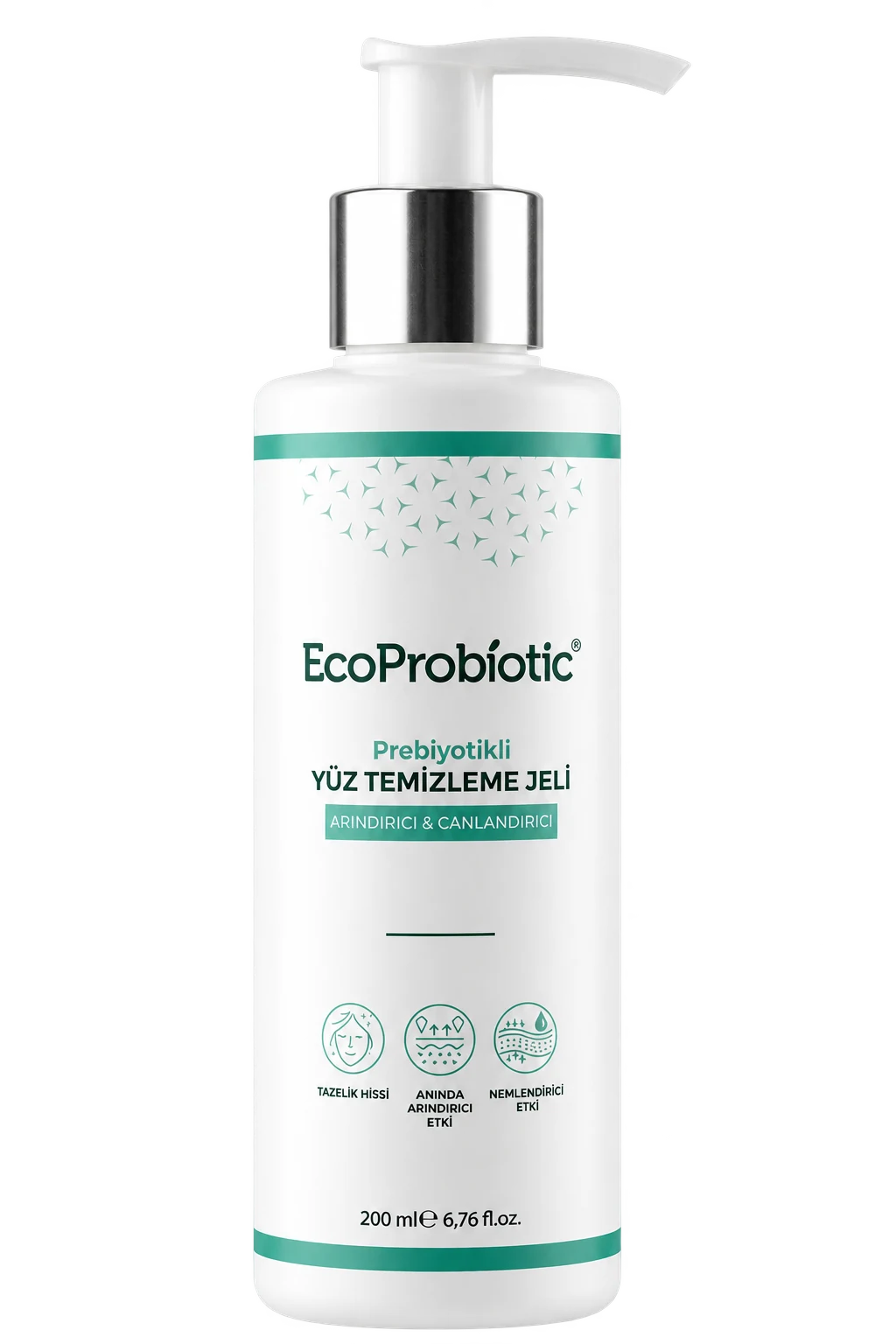 CleansingPrebiotic Face Cleansing GelRemoves make-up and the day’s grime with a gentle foam, supporting the skin barrier as it cleanses. Morning and evening.View ↗
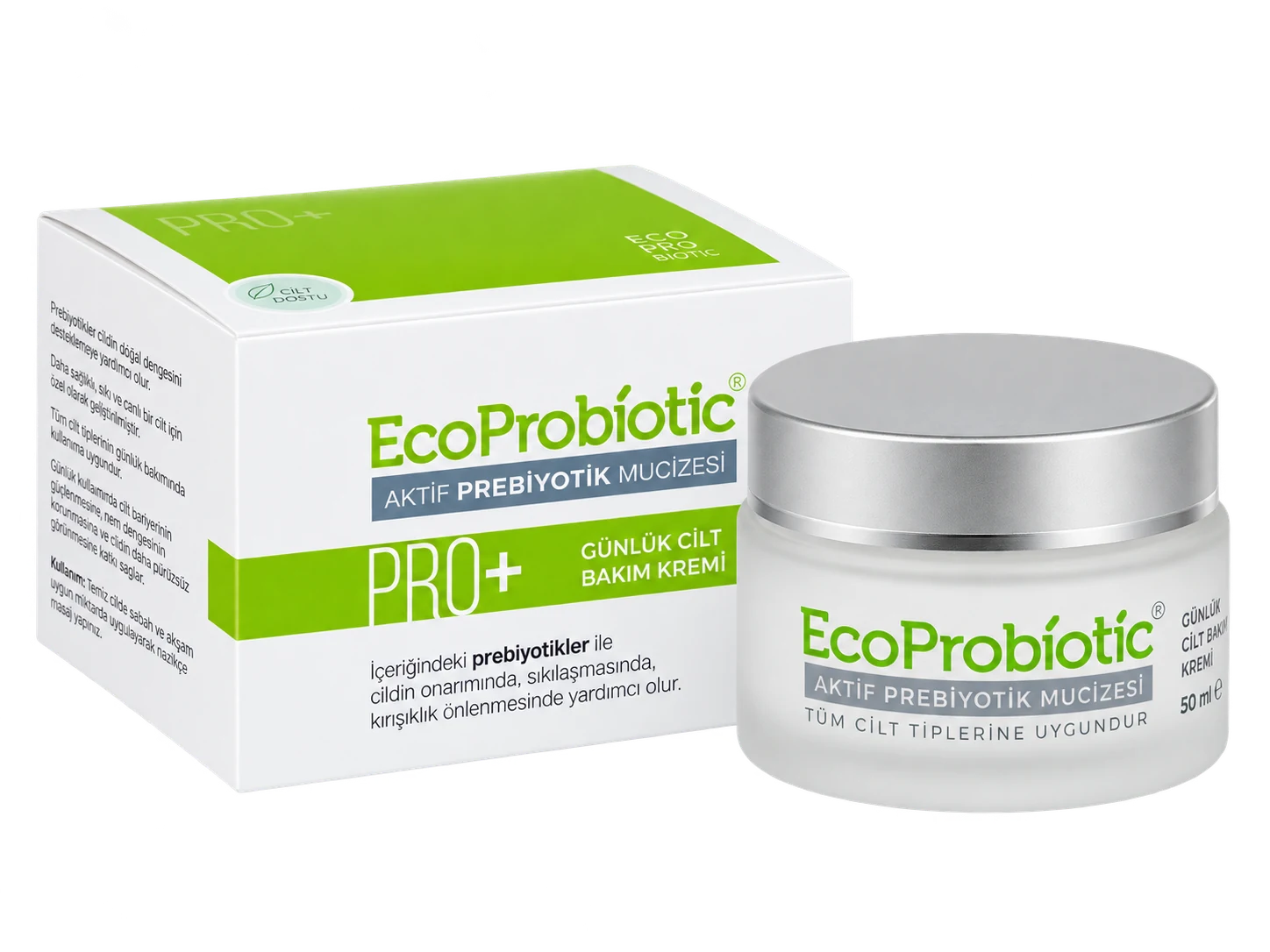 MoisturisingPrebiotic Skin CreamMoisturises the skin and helps repair the barrier. Available in three formulas: for all, dry and oily skin.View ↗
Sources
- 1.Expert consensus document: The International Scientific Association for Probiotics and Prebiotics consensus statement on the scope and appropriate use of the term probiotic
Hill C, Guarner F, Reid G, Gibson GR, Merenstein DJ, Pot B ve ark. · Nature Reviews Gastroenterology & Hepatology · 2014 · doi:10.1038/nrgastro.2014.66
Defined probiotics as live microorganisms that confer a health benefit when administered in adequate amounts.
- 2.Expert consensus document: The International Scientific Association for Probiotics and Prebiotics (ISAPP) consensus statement on the definition and scope of prebiotics
Gibson GR, Hutkins R, Sanders ME, Prescott SL, Reimer RA, Salminen SJ ve ark. · Nature Reviews Gastroenterology & Hepatology · 2017 · doi:10.1038/nrgastro.2017.75
Defined a prebiotic as a substance selectively used by host microorganisms that confers a health benefit, and noted that the scope may include the skin.
- 3.The International Scientific Association of Probiotics and Prebiotics (ISAPP) consensus statement on the definition and scope of postbiotics
Salminen S, Collado MC, Endo A, Hill C, Lebeer S, Quigley EMM ve ark. · Nature Reviews Gastroenterology & Hepatology · 2021 · doi:10.1038/s41575-021-00440-6
Defined a postbiotic as a preparation of inanimate microorganisms and/or their components that confers a health benefit.
- 4.Impact of prebiotics and probiotics on skin health
Al-Ghazzewi FH, Tester RF · Beneficial Microbes · 2014 · doi:10.3920/BM2013.0040
Reviewed findings suggesting that prebiotics and probiotics may help support skin hydration, the barrier and microbial balance.
- 5.The role of topical probiotics in skin conditions: A systematic review of animal and human studies and implications for future therapies
Knackstedt R, Knackstedt T, Gatherwright J · Experimental Dermatology · 2020 · doi:10.1111/exd.14032
Reported that some positive results were observed in topical probiotic studies, but that larger studies are needed.
- 6.Changing our microbiome: probiotics in dermatology
Yu Y, Dunaway S, Champer J, Kim J, Alikhan A · British Journal of Dermatology · 2020 · doi:10.1111/bjd.18088
Summarized the areas in which probiotics have been studied in dermatology and stressed that the evidence is still at an early stage.