Definition
What is Hair loss from stress, dieting and after pregnancy?
Our hair is in a constant cycle: a long growth phase, a short transition phase and a resting phase called telogen. Normally most hairs are in the growth phase, and every day a certain number of strands complete the resting phase and fall out naturally. In telogen effluvium, a shock the body goes through, such as an illness with a high fever, childbirth, severe stress, rapid weight loss or a change in medication, pushes many hairs into the resting phase early, all at the same time.
After these hairs complete the resting phase, about 3–4 months after the trigger, they start falling out together. The shedding happens evenly from all over the scalp; no bald patch forms, but the overall density of the hair decreases. A small white bulb is seen at the base of the shed strands; this shows the strand separated from its root in a healthy way. Telogen effluvium is one of the most common causes of diffuse, non-scarring hair loss, and women see a dermatologist for it more often.
The good news: the hair follicles aren't damaged. Once the trigger is gone, shedding usually slows within 6 months and new hair starts to grow. But it takes months for new hair to reach its old length and fullness. If the trigger continues or keeps recurring, shedding can become chronic and last longer than 6 months; in that case a dermatologist's help in finding the cause is important.
Check yourself
How do you recognise it?
- ✓Noticeably more hair falling out while washing and brushing
- ✓Lots of strands on your pillow, clothes and in the sink
- ✓A small white bulb at the base of shed strands
- ✓Even, diffuse shedding from all over the scalp, with no bald patches
- ✓A ponytail that gets thinner within a few months
- ✓Mild thinning at the temples and front hairline
- ✓In some women, pain, tenderness or a prickling feeling on the scalp
- ✓A few strands coming out easily in your hand when gently pulled
- ✓A few months later, short new hairs growing along the hairline
Why it happens
Main causes
01
Illnesses with fever and surgery
Infections with high fever, serious illnesses and major surgery are among the most common triggers. Shedding usually starts 2–4 months after the illness.
02
Childbirth and hormonal changes
Many women notice significant shedding after giving birth. However, a review of the scientific literature noted that how often postpartum hair loss occurs is less clear than assumed, and that there is no strong data showing a difference between pregnancy and the postpartum period. Stopping birth control pills can also be a trigger.
03
Intense psychological stress
Periods of severe stress such as loss, divorce, job loss or long-lasting anxiety can affect the hair cycle. Keep in mind that stress can be both a cause and a result of hair loss.
04
Rapid weight loss and poor nutrition
Diets that are very restrictive in calories and protein, rapid weight loss and eating disorders can disrupt the hair cycle. Iron deficiency has also been linked to hair shedding in women.
05
Thyroid and other systemic problems
An underactive or overactive thyroid, anemia and some chronic illnesses can lead to telogen effluvium. That's why an assessment with blood tests is important.
06
Medications
Starting or stopping some blood pressure medications, blood thinners, retinoids, thyroid medications and hormone therapies can trigger shedding. Always talk to your doctor before stopping any medication on your own.
In daily life
Triggers that cause flare-ups
Medical approach
Treatment options
01
Finding the cause
The foundation of treatment is finding and removing the factor that triggered the shedding. The dermatologist asks about illnesses, childbirth, diets, stress and medication changes in the last 3–6 months; if needed, they perform a hair pull test and scalp imaging.
02
Blood tests
Iron stores (ferritin), a complete blood count, thyroid hormones, vitamin D and other values if needed are checked. Any deficiencies found are corrected under a doctor's supervision.
03
Waiting and being informed
In acute telogen effluvium the hair follicles are intact, so shedding usually slows on its own. Understanding the hair cycle and knowing the shedding is temporary reduces anxiety and helps break the stress cycle.
04
Minoxidil
In chronic or marked cases, based on your dermatologist's assessment, minoxidil applied to the scalp can help recovery by supporting the growth phase.
05
Treating accompanying scalp problems
If there are scalp problems such as dandruff or seborrheic dermatitis, treating them is recommended. Clearing flaking and good hair care are an important part of managing hair loss.
06
Ruling out underlying female pattern hair loss
Telogen effluvium can sometimes unmask female pattern hair loss that's been quietly progressing underneath. If shedding lasts longer than 6 months, the dermatologist also considers this possibility.
Did you know? · Hair loss from stress, dieting and after pregnancy
3–4 months · In telogen effluvium, diffuse hair shedding usually starts 3–4 months after the triggering event; that's why the cause is often overlooked.
Step by step
Care routine for Hair loss from stress, dieting and after pregnancy
- 1
Gentle brushing
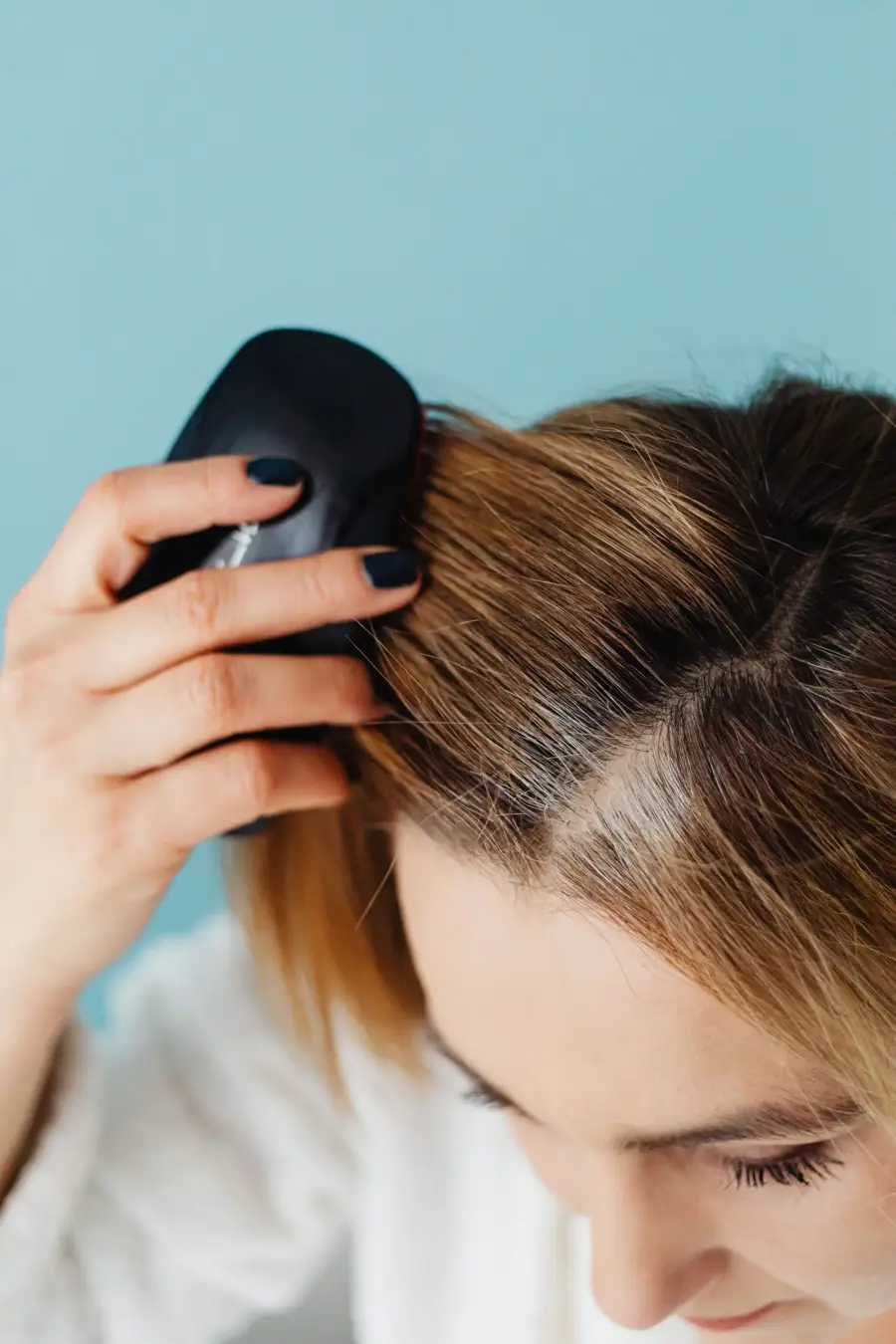
Comb your hair with a wide-tooth comb, starting from the ends. Instead of counting the hairs that fall out, keep your comb and brush clean.
- 2
Scalp treatment or tonic
If your dermatologist recommended a treatment, apply it as described. If you have itching or sensitivity, you can use an alcohol-free, soothing scalp tonic.
- 3
Loose hairstyles
Avoid tight buns and ponytails during this period; choose loose styles that don't put extra strain on the roots.
- 4
A solid breakfast
A breakfast rich in protein and iron provides the building blocks the hair cycle needs.

Caution
What to avoid, and when to see a doctor?
Avoid these
- ✕Not washing your hair for days out of fear of hair loss
- ✕Sticking with overly restrictive diets to lose weight fast
- ✕Stopping a medication or changing a dose without consulting your doctor
- ✕Taking high-dose hair vitamins without a deficiency
- ✕Tight buns, heavy hair extensions and chemical treatments
- ✕Constantly counting shed strands and feeding your anxiety
- ✕Wasting time on unproven “miracle” products
See a dermatologist
- →If shedding lasts longer than 6 months or keeps increasing
- →If there are obvious bald patches, or hair loss from your eyebrows or eyelashes
- →If it comes with symptoms such as weakness, palpitations, weight changes, feeling cold or heat intolerance
- →If you have irregular periods, acne or increased hair growth
- →If there is redness, flaking, pain or sores on your scalp
- →If shedding started after a medication you recently began
Common misconceptions
Myth or fact?
Myth
If I'm losing this much hair, I'm going to go bald.
Fact
In telogen effluvium the hair follicles are intact. Once the trigger is gone, shedding usually slows and new hair grows; permanent baldness isn't expected.
Myth
Every woman's hair falls out after giving birth.
Fact
Postpartum shedding is often talked about, but a review of the literature noted that its true frequency is unknown and that no difference compared with pregnancy could be proven.
Myth
Cutting your hair stops hair loss.
Fact
Cutting your hair doesn't change the cycle at the root. But shorter hair can look fuller and be easier to care for.
Popular searches
Most asked about Hair loss from stress, dieting and after pregnancy
Your questions
Frequently asked questions
How long does telogen effluvium last?+
In acute telogen effluvium, shedding usually slows within 6 months. It can take anywhere from months to a year or two for new hair to reach its old length and fullness. If the trigger continues, shedding may last longer.
How much hair loss a day is normal?+
Losing some hair every day is a natural part of the hair cycle. What matters is whether there's a noticeable increase compared with your own normal and a decrease in hair density.
Is hair loss after COVID-19 also telogen effluvium?+
Infections with high fever, including COVID-19, are known triggers of telogen effluvium. Shedding usually starts 2–3 months after the illness and recovers on its own in most people.
Which blood tests should I get?+
Your dermatologist usually checks iron stores, a complete blood count, thyroid hormones and vitamin D. Other values may also be requested depending on your symptoms.
Can stress really make your hair fall out?+
Yes, intense stress can affect hair follicles through hormones and nerve messenger substances that can influence the hair cycle. The shedding itself can also create stress and form a vicious cycle; that's why it's important to know the condition is temporary.
How should I care for my scalp during this time?+
Wash your hair regularly and gently, avoid harsh treatments and keep your scalp free of itching and flaking. Fragrance-free, light care products and, when needed, scalp care with prebiotics can help support comfort during this period.
Does hair lost from stress grow back?+
In telogen effluvium the hair follicles aren't damaged, so once stress or another trigger is gone, hair usually grows back. Shedding often slows within 6 months; but it takes months for new hair to reach its old length. Short, upright new hairs appearing along your part and hairline are a good sign of recovery.
When does postpartum hair loss stop?+
As hormones shift rapidly after giving birth, shedding usually starts in months 2–4. In most women it slows within a few months, and hair density recovers toward the end of the first year. Because iron deficiency and thyroid problems can prolong shedding, it's helpful to get blood tests if it lasts longer than expected.
Is seasonal hair shedding real?+
In some people, hair shedding may increase somewhat, especially in fall; this has to do with natural fluctuations in the hair cycle. This shedding is usually mild and decreases on its own within a few weeks. If there's a noticeable decrease in hair density or the shedding lasts longer than 2–3 months, see a dermatologist to look into the cause.
What helps sudden hair loss?+
The most effective step is finding and removing the cause that started the shedding: correcting iron or vitamin D deficiency, getting a thyroid problem treated, getting enough protein and calories, and managing stress. Washing your hair gently and avoiding tight buns and frequent heat styling reduce breakage. If shedding lasts longer than 6 months, your dermatologist may recommend additional treatments.
Scientific basis
Sources
- 1.Telogen Effluvium: A Review
Malkud S · Journal of Clinical and Diagnostic Research · 2015 · doi:10.7860/JCDR/2015/15219.6492
Stated that telogen effluvium is the most common cause of diffuse hair loss and that shedding begins 3–4 months after the triggering event.
- 2.Telogen effluvium
Grover C, Khurana A · Indian Journal of Dermatology, Venereology and Leprology · 2013 · doi:10.4103/0378-6323.116731
Stressed the importance of distinguishing telogen effluvium from female pattern hair loss and that stress can be both a cause and a result.
- 3.Telogen Effluvium: A Review of the Literature
Asghar F, Shamim N, Farooque U, Sheikh H, Aqeel R · Cureus · 2020 · doi:10.7759/cureus.8320
Reviewed how medications, trauma and physical or emotional stress can trigger telogen effluvium, and that finding and removing the cause is key to treatment.
- 4.The Postpartum Telogen Effluvium Fallacy
Mirallas O, Grimalt R · Skin Appendage Disorders · 2016 · doi:10.1159/000445385
Showed that there is no statistically significant data in the literature supporting a difference in hair loss between pregnancy and the postpartum period.
- 5.Nutritional factors and hair loss
Rushton DH · Clinical and Experimental Dermatology · 2002 · doi:10.1046/j.1365-2230.2002.01076.x
Noted that iron stores are linked to increased hair shedding in women, and that washing hair less often out of fear increases the perception of shedding.
- 6.The Role of Vitamins and Minerals in Hair Loss: A Review
Almohanna HM, Ahmed AA, Tsatalis JP, Tosti A · Dermatology and Therapy · 2019 · doi:10.1007/s13555-018-0278-6
Reviewed the role of micronutrients such as iron, zinc and vitamin D in the hair cycle, and how deficiencies may be a modifiable risk factor.
- 7.Neuroimmunology of stress: skin takes center stage
Arck PC, Slominski A, Theoharides TC, Peters EM, Paus R · Journal of Investigative Dermatology · 2006 · doi:10.1038/sj.jid.5700104
Reviewed how the skin and hair follicles are both a target and a source of stress hormones, and the connection between the brain and the skin.
- 8.The role of the microbiome in scalp hair follicle biology and disease
Polak-Witka K, Rudnicka L, Blume-Peytavi U, Vogt A · Experimental Dermatology · 2020 · doi:10.1111/exd.13935
Reviewed possible interactions of microorganisms living in hair follicles with the immune system and the hair cycle.